Ligament Reconstruction Surgery in Delhi — ACL, PCL: Who Needs It & When
Ligament reconstruction surgery may be needed when a torn ACL or PCL causes knee instability, recurrent giving-way, pain, or inability to return to sport and daily activities. Not every ligament injury requires surgery; the decision depends on the extent of the tear, associated injuries, activity level, and knee stability.
For active adults in Delhi NCR—especially those aged 20 to 40 who play sports, run, cycle, go to the gym, or have physically demanding jobs—an untreated ligament injury can lead to repeated knee instability and further cartilage or meniscus damage.
What are ACL and PCL ligaments?
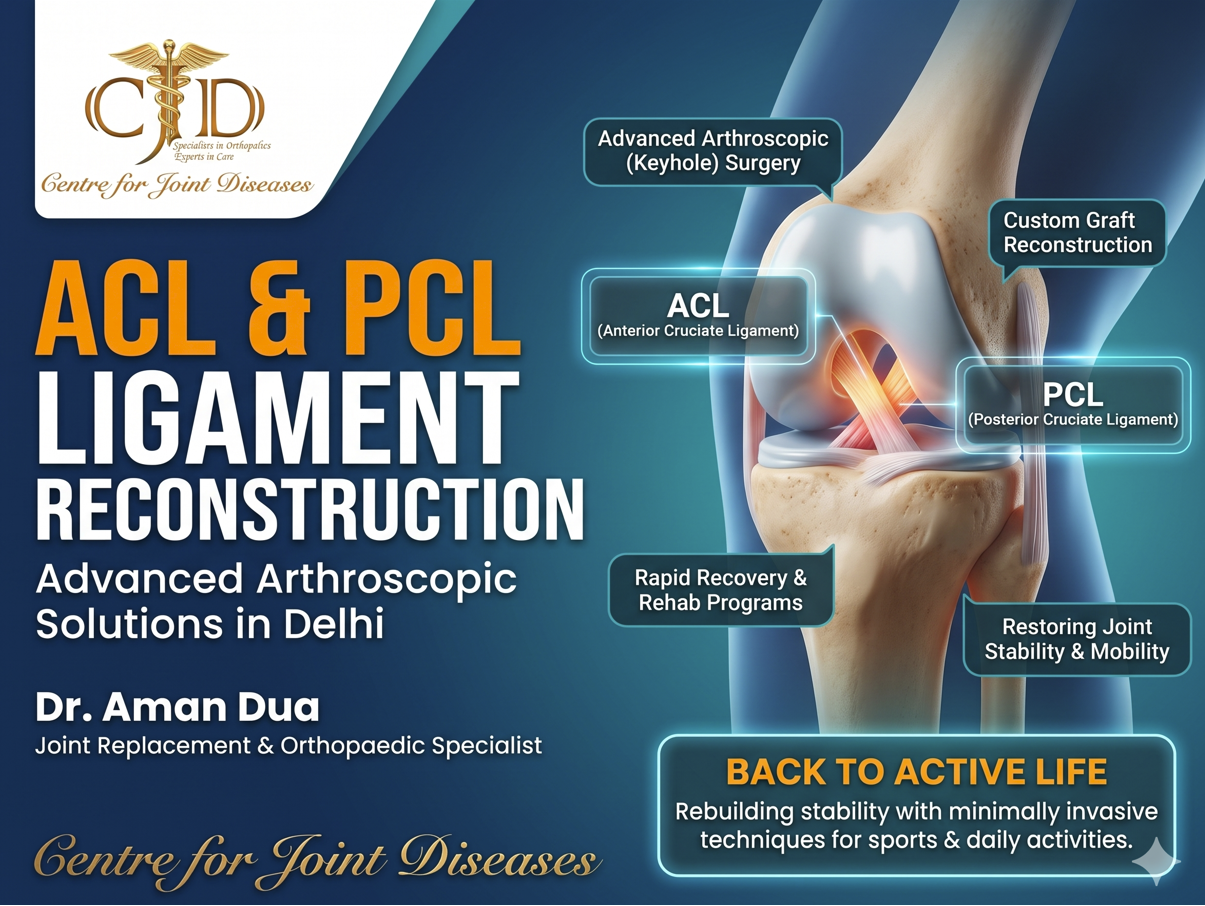
The ACL (anterior cruciate ligament) and PCL (posterior cruciate ligament) are two major ligaments inside the knee. They connect the thigh bone to the shin bone and help control stability during movement.
- ACL: Prevents the shin bone from moving too far forward and controls rotation of the knee.
- PCL: Prevents the shin bone from moving too far backward and helps maintain overall knee stability.
These ligaments are commonly injured during sports involving sudden stopping, twisting, jumping, pivoting, or direct impact to the knee.
What causes ACL and PCL injuries?
Common causes include:
- Sudden change of direction while playing football, cricket, basketball, badminton, or kabaddi.
- Landing awkwardly after a jump.
- Twisting the knee while the foot is fixed.
- Road accidents or falls.
- Direct blow to the front of the knee, which is more typical in PCL injuries.
- Combined injuries involving the meniscus, cartilage, or other ligaments.
What are the symptoms of an ACL or PCL tear?
Typical symptoms include:
- A popping sensation at the time of injury.
- Immediate swelling in the knee.
- Pain and difficulty bearing weight.
- A feeling that the knee is unstable or “giving way.”
- Difficulty twisting, turning, squatting, or returning to sport.
- Repeated episodes of instability.
- Reduced confidence while walking on uneven surfaces.
Some PCL injuries may present with more subtle instability, especially during stairs, squatting, or downhill walking.
Does every ACL or PCL tear need surgery?
No. Treatment is individualised.
Non-surgical management may be appropriate for some partial tears, low-demand patients, or injuries with minimal instability. It may include bracing, activity modification, pain and swelling control, and structured rehabilitation.
Surgery is often considered when:
- The ligament is completely torn and the knee remains unstable.
- The patient wants to return to sports involving cutting, pivoting, or agility.
- The knee repeatedly gives way despite rehabilitation.
- There is an associated repairable meniscus tear.
- Multiple ligaments are injured.
- The injury affects work, daily activities, or long-term knee function.
What is ligament reconstruction surgery?
ACL and PCL reconstruction involves replacing the torn ligament with a graft. The graft may be taken from the patient’s own tissue, commonly from the hamstring tendon or kneecap tendon, or may be a donor graft in selected cases.
The surgeon creates small tunnels in the bone, places the graft in the position of the original ligament, and fixes it securely. Over time, the graft heals and integrates with the surrounding bone.
The goal is not simply to repair the ligament but to restore knee stability, protect the meniscus and cartilage, and allow a safe return to activity.
ACL reconstruction: who needs it?
ACL reconstruction may be recommended for:
- Young, active patients who want to return to sport.
- Patients with recurrent knee instability.
- People whose knee gives way during routine activities.
- Patients with an ACL tear plus a repairable meniscus injury.
- Patients with multi-ligament knee injuries.
- Those whose occupation requires pivoting, squatting, climbing, or physical agility.
Delaying surgery in an unstable ACL-deficient knee may increase the risk of further meniscus or cartilage injury in some patients.
PCL reconstruction: who needs it?
PCL injuries are less common than ACL injuries and are sometimes managed without surgery initially. PCL reconstruction may be considered when:
- The PCL is completely torn.
- The knee remains unstable despite rehabilitation.
- There is significant posterior laxity.
- Other ligaments or structures are also injured.
- The patient has persistent pain, instability, or functional limitation.
- The patient wants to return to sport or a physically demanding lifestyle.
Because PCL injuries can occur with other knee injuries, a detailed clinical examination and imaging assessment are important.
How is the diagnosis made?
Diagnosis usually includes:
- Detailed history of the injury.
- Clinical knee examination and stability testing.
- X-rays to assess fractures and alignment.
- MRI to assess the ACL, PCL, meniscus, cartilage, and other ligaments.
- Assessment of muscle strength, swelling, movement, and walking pattern.
An accurate diagnosis is essential because ACL and PCL injuries may occur with meniscus tears, cartilage damage, collateral ligament injuries, or bone bruises.
What is recovery like after ligament reconstruction?
Recovery varies by injury, graft type, associated injuries, and rehabilitation. A typical broad pattern is:

These timelines are approximate. Returning to sport too early can increase the risk of re-injury, so clearance should be based on functional progress—not just time since surgery.
What are the risks of ligament reconstruction?
Possible risks include:
- Infection.
- Blood clots.
- Stiffness.
- Graft failure or re-injury.
- Persistent instability.
- Pain or swelling.
- Injury to nearby nerves or blood vessels.
- Need for further surgery in some cases.
Choosing an experienced knee surgeon and following a structured rehabilitation plan can help reduce avoidable risks.
Why early assessment matters
Many young patients ignore a knee injury, hoping it will settle on its own. While some minor sprains do settle, a significant ACL or PCL injury can cause repeated instability and damage to the meniscus or cartilage if not assessed properly.
Early evaluation helps determine whether conservative treatment is enough or whether reconstruction is needed to protect long-term knee health.
Why consult Dr. Aman Dua?
Dr. Aman Dua is an orthopedic and knee and hip joint replacement surgeon with M.S. Orthopedics from AIIMS, New Delhi, D.N.B. Orthopedics, and 23 years of experience. His practice, Centre For Joint Diseases, provides assessment and treatment for knee ligament injuries, sports injuries, and joint disorders in Delhi.
Book a knee injury consultation in Delhi
If you have knee swelling, instability, a popping injury, or difficulty returning to sport after an ACL or PCL injury, seek a specialist assessment.
Dr. Aman Dua
Centre For Joint Diseases
Fortis Escorts Hospital, Okhla Road, Near Sukhdev Vihar Metro Station, Delhi 110025
Phone: +91 9625440750
Hospital contact: +91-8750005633
Timings: Monday–Saturday, 10:00 AM–4:00 PM
Website: https://www.fasttrackkneereplacement.com/
FAQs
Can an ACL tear heal without surgery?
Some partial injuries or low-demand patients may be managed without surgery. However, complete ACL tears with persistent instability or a desire to return to pivoting sports often require reconstruction.
Is PCL injury serious?
PCL injuries can range from mild to severe. Some are managed conservatively, while complete tears or combined ligament injuries may require reconstruction.
How soon after injury should ACL surgery be done?
Timing depends on swelling, range of motion, muscle control, and associated injuries. Some patients need prehabilitation before surgery; others may need earlier intervention, especially with a repairable meniscus tear or multi-ligament injury.
Can I return to sports after ACL reconstruction?
Many patients can return to sport after completing a structured rehabilitation programme and achieving adequate strength, stability, and functional milestones. The timeline varies and should be guided by the surgeon and physiotherapist.
What happens if an ACL tear is left untreated?
An unstable knee may repeatedly give way, increasing the risk of meniscus or cartilage injury over time. However, treatment should always be individualised after proper assessment.
Keywords