Partial vs Total Knee Replacement — Which One Do You Need?
If arthritis affects only one part of your knee, a partial knee replacement may be possible; if damage involves more than one compartment, severe deformity is present, or the ligaments are unstable, a total knee replacement is usually more appropriate. The right option depends on your X-rays, examination, symptoms, and overall knee condition—not on age alone.
Many patients assume that a partial replacement is always “better” because it is smaller. That is not always true. The best surgery is the one that matches the actual pattern of arthritis in your knee.
What is a partial knee replacement?
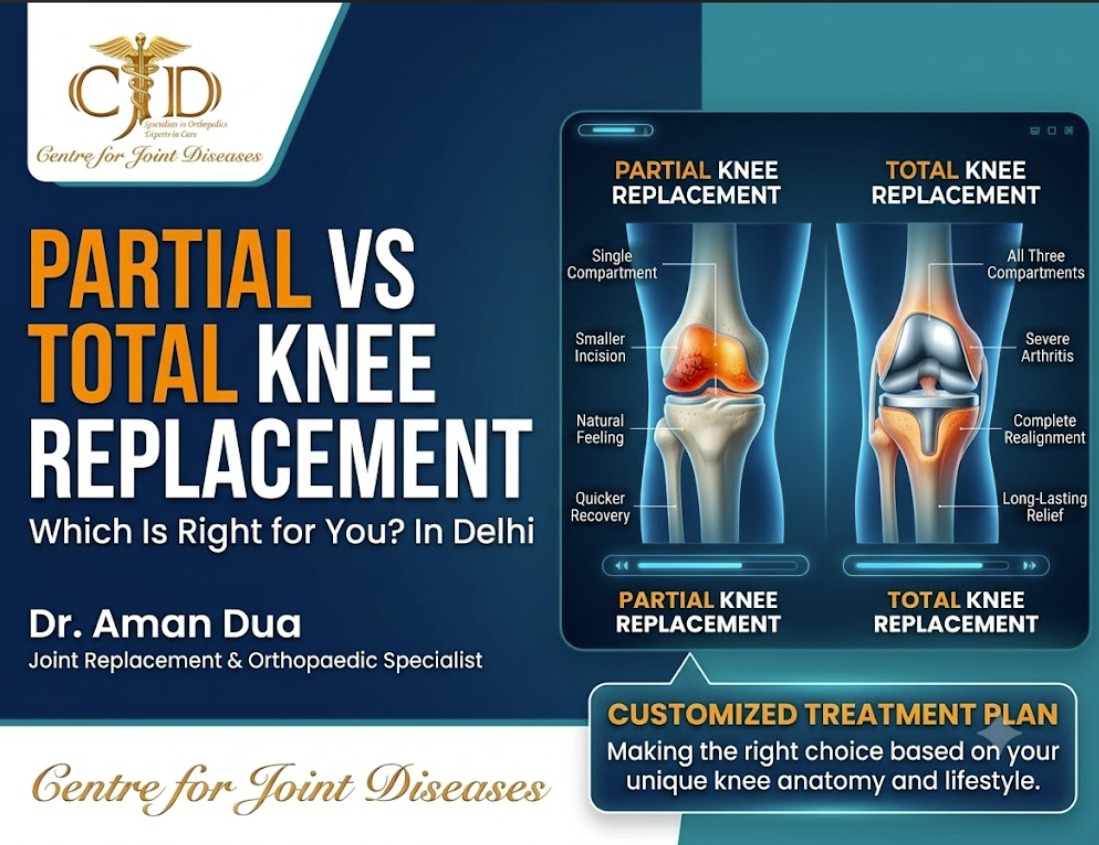
A partial knee replacement, also called unicompartmental knee replacement, replaces only the damaged compartment of the knee. The knee has three main compartments:
- Medial compartment: inner side of the knee.
- Lateral compartment: outer side of the knee.
- Patellofemoral compartment: area beneath the kneecap.
In a partial replacement, only the affected compartment is resurfaced, while healthy cartilage, ligaments, and bone in the other parts of the knee are preserved. Partial knee replacement is generally considered when arthritis is limited to one compartment.
What is a total knee replacement?
A total knee replacement replaces the damaged surfaces of the knee joint across the major weight-bearing areas. It is commonly recommended when arthritis affects more than one compartment, the knee is significantly deformed, movement is severely restricted, or the ligaments cannot support a partial replacement.
Total knee replacement remains one of the most reliable procedures for advanced arthritis that affects the whole knee. It is not a “bigger surgery for no reason”; it is often the appropriate choice when the disease pattern requires it.
Partial vs total knee replacement: key differences
FactorPartial knee replacementTotal knee replacementArea replacedOnly one damaged compartment.Damaged surfaces across the knee joint.Best suited forArthritis limited to one compartment with stable ligaments.Arthritis in multiple compartments, significant deformity, or instability.Bone and tissue preservationMore healthy bone and ligament tissue may be preserved.More extensive resurfacing is required.RecoveryOften quicker because the procedure is less extensive. Recovery may take longer, though many patients walk with support soon after surgery. Knee feelSome patients report a more natural-feeling knee because more native tissue is retained. Provides a stable, durable solution for more widespread arthritis.SuitabilityLimited to carefully selected patients.Suitable for a broader range of advanced arthritis patterns.
Who may be suitable for partial knee replacement?
Partial knee replacement may be considered when:
- Arthritis is limited to one compartment of the knee.
- Pain is mainly localised to one side of the knee.
- The ligaments are stable.
- Knee movement is reasonably preserved.
- Deformity is mild or absent.
- The cartilage under the kneecap and in the other compartments is not severely damaged.
Patients with inflammatory arthritis, widespread cartilage loss, major bow-leg or knock-knee deformity, significant stiffness, or ligament instability may not be ideal candidates for a partial replacement.
Who may need total knee replacement?
Total knee replacement may be more suitable when:
- Arthritis affects two or more compartments.
- Pain is diffuse rather than limited to one area.
- The knee is significantly bowed or knock-kneed.
- The knee is stiff or has very limited movement.
- Ligaments are weak or unstable.
- A previous partial knee replacement has failed or arthritis has progressed.
Which surgery recovery is faster?
Partial knee replacement often allows a faster initial recovery because less bone and soft tissue are disturbed. Many eligible patients recover more quickly and may walk without a walker or cane within approximately three to four weeks, though this varies from person to person.[medlineplus]
Total knee replacement recovery is usually more demanding in the early weeks, but most patients walk with assistance soon after surgery and continue improving with physiotherapy and follow-up.
Recovery depends on more than the type of surgery. Age, fitness, pre-surgery mobility, weight, medical conditions, surgical technique, and rehabilitation all influence the timeline.
Does partial knee replacement last as long as total knee replacement?
Both procedures can provide long-term relief when appropriately selected and properly performed. However, partial knee replacement depends heavily on correct patient selection. If arthritis progresses in the untouched compartments, further surgery may sometimes be needed later.
Total knee replacement is generally preferred when arthritis is more widespread because it addresses the larger area of joint damage. Your surgeon will assess the risk of progression and recommend the option that offers the most dependable long-term solution for your knee.
What are the risks?
Both partial and total knee replacement are major procedures and carry risks, including:
- Infection.
- Blood clots.
- Stiffness.
- Persistent pain.
- Implant loosening or wear over time.
- Injury to nerves or blood vessels.
- Need for revision surgery in some cases.
The risk profile differs between patients. Diabetes, obesity, smoking, heart disease, poor mobility, and other medical conditions can influence surgical planning and recovery.
How does a surgeon decide which option you need?
The decision is based on a complete assessment, including:
- Location and severity of pain.
- Walking pattern and ability to climb stairs.
- Knee alignment and deformity.
- Range of motion.
- Ligament stability.
- X-rays and, when required, advanced imaging.
- Response to medicines, physiotherapy, injections, and lifestyle changes.
- Age, weight, activity goals, and medical fitness.
A partial knee replacement should not be chosen only because it sounds less invasive. It should be chosen because your arthritis pattern genuinely fits the criteria.
Why an accurate diagnosis matters
Choosing between partial and total knee replacement is one of the most important decisions in knee arthritis care. An incorrect selection can lead to incomplete pain relief, early failure, or the need for revision surgery.
Dr. Aman Dua is an orthopedic and knee and hip joint replacement surgeon with M.S. Orthopedics from AIIMS, New Delhi, D.N.B. Orthopedics, and 23 years of experience. His practice, Centre For Joint Diseases, focuses on knee arthritis, joint replacement, and related orthopedic care in Delhi.
Book a knee assessment in Delhi
If you have persistent knee pain and are unsure whether you need a partial or total knee replacement, a specialist consultation can help you understand the most suitable treatment path.
Dr. Aman Dua
Centre For Joint Diseases
Fortis Escorts Hospital, Okhla Road, Near Sukhdev Vihar Metro Station, Delhi 110025
Phone: +91 9625440750
Hospital contact: +91-8750005633
Timings: Monday–Saturday, 10:00 AM–4:00 PM
Website: https://www.fasttrackkneereplacement.com/
FAQs
Is partial knee replacement better than total knee replacement?
Neither is universally better. Partial knee replacement may be better for carefully selected patients with arthritis in only one compartment, while total knee replacement is usually more appropriate for widespread arthritis or significant deformity.
Can arthritis spread after partial knee replacement?
Yes, arthritis can sometimes progress in the untreated compartments. This is why proper patient selection and follow-up are important.
Is recovery faster after partial knee replacement?
Often, yes. Because the procedure is less extensive, eligible patients may experience a quicker early recovery than after total knee replacement.
Can a partial knee replacement be converted to a total knee replacement?
In some cases, yes. If arthritis progresses or the partial replacement fails, revision to a total knee replacement may be required.
How do I know which knee replacement I need?
You need a clinical examination, X-rays, and a specialist assessment. The decision depends on the location of arthritis, knee alignment, ligament status, movement, and your overall health.
Keywords