

Robotic Knee Replacement in South Delhi: A Patient's Guide to State-of-the-Art Knee Surgery
Reviewed and written by Dr. Aman Dua, Joint Replacement Surgeon, Fortis Escorts Hospital, Okhla Road, Near Sukhdev Vihar Metro Station, Delhi.
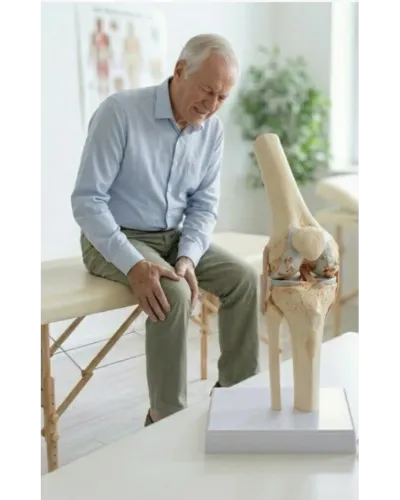
If knee pain has started dictating your day — which stairs you avoid, when you sit down for a temple visit, whether you can still play with your grandchildren in the park — you are not alone. Every week, patients from Sukhdev Vihar, Kalkaji, Greater Kailash, Nehru Place, Jasola and across South Delhi walk into our clinic asking the same question: 'Is there a more precise, less painful way to get my knee fixed?' Increasingly, the answer is robotic-assisted knee replacement — and specifically, the VELYS Robotic-Assisted Solution.
This blog explains, in plain language, what VELYS robotic knee replacement is, who needs it, how the surgery actually works, and what recovery looks like — so you can have an informed conversation at your next appointment.
Do These Knee Symptoms Sound Familiar?
Most patients who eventually consider knee replacement have been living with gradually worsening symptoms for years. Common warning signs we see in our South Delhi clinic include:
- Pain while climbing or descending stairs, or getting up from a low sofa or Indian-style toilet
- Morning stiffness in the knee that takes several minutes to 'loosen up'
- A grinding or clicking sensation (crepitus) when bending or straightening the knee
- Visible swelling or warmth around the joint, especially after walking
- Reduced walking distance — needing to stop and rest after a few hundred metres
- Bow-leggedness or knock-knee deformity that has become more noticeable over time
- Pain that disturbs sleep or persists even at rest, not just with activity
- Feeling that the knee is 'giving way' or feels unstable while walking on uneven ground
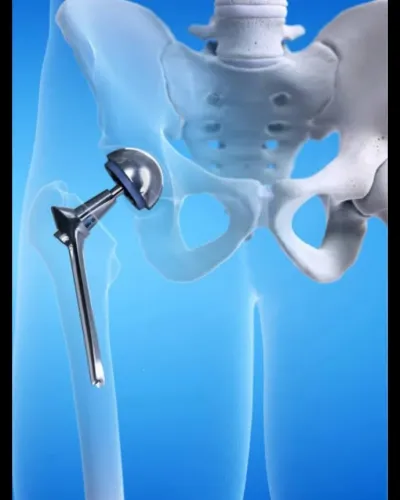
These are classic signs of advanced knee osteoarthritis — progressive wearing away of the cartilage that cushions the joint. When physiotherapy, weight management, medication, and injections stop giving lasting relief, knee replacement is generally the most effective next step.
What Is VELYS Robotic-Assisted Knee Replacement?
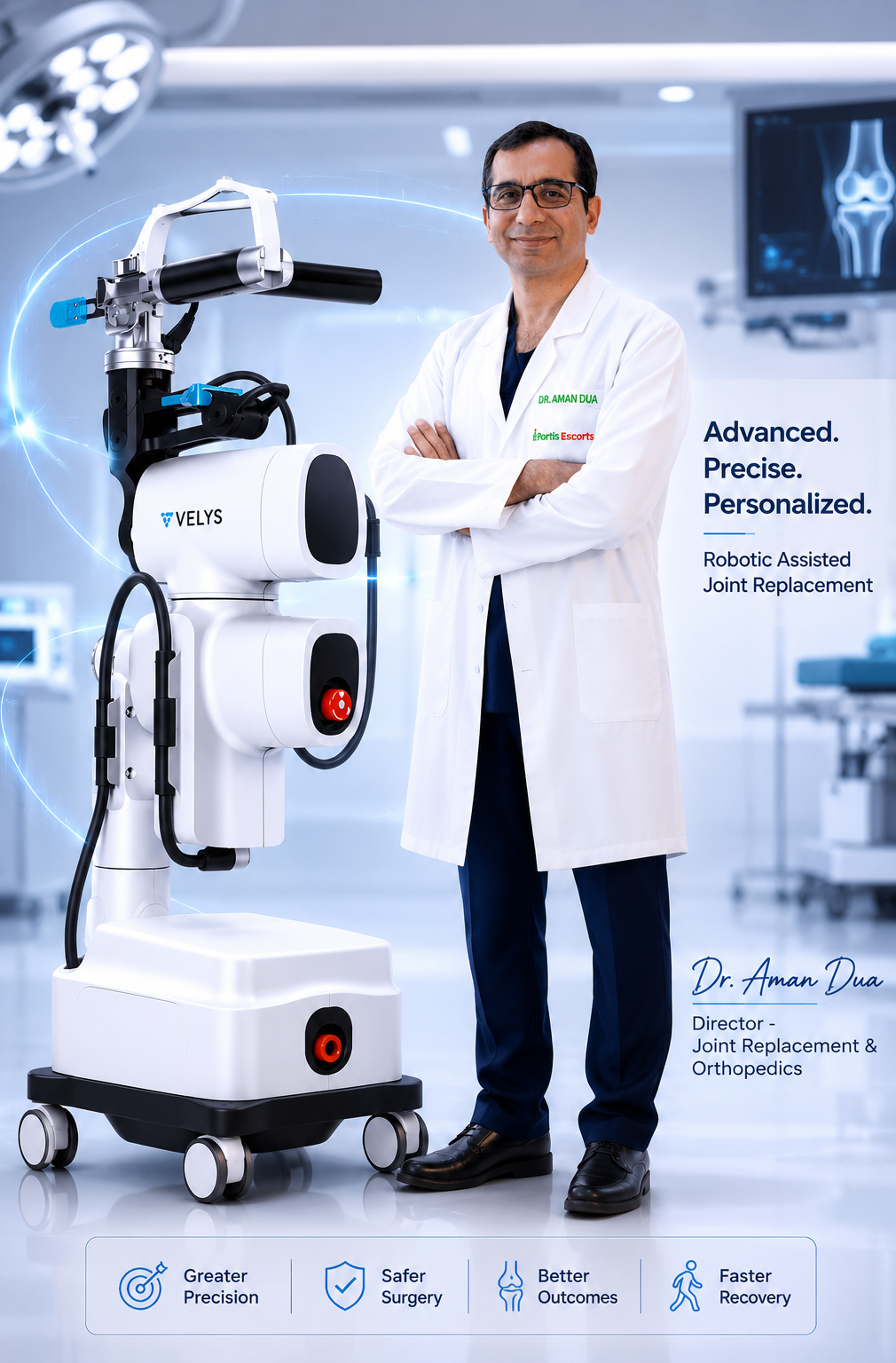
The VELYS Robotic-Assisted Solution is a digital surgical platform developed by DePuy Synthes (Johnson & Johnson MedTech) that works alongside the surgeon during total knee replacement. It is important to understand one thing clearly: the robot does not operate on its own and does not make decisions. It is a highly precise assistant that gives the surgeon real-time, personalised data about your unique knee anatomy, so that every bone cut and every millimetre of implant positioning is planned specifically for your leg — not a generic average.
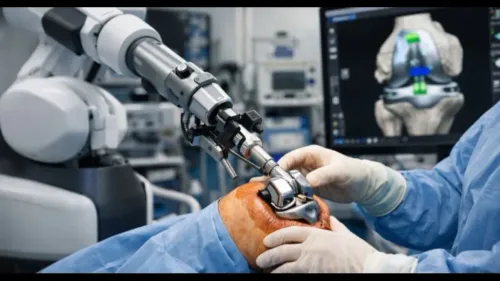
Unlike some robotic systems that require a pre-operative CT scan, VELYS uses an imageless technology. During surgery, infrared cameras and optical trackers map your knee's exact anatomy, ligament tension, and range of motion live in the operating room. This data is displayed on a screen, allowing your surgeon to fine-tune the surgical plan before a single cut is made.
How the VELYS Procedure Works, Step by Step
- Anatomical mapping: Small trackers are placed on the thigh and shin bones. The system registers your knee's unique landmarks — no CT scan needed.
- Dynamic ligament balancing: Your surgeon moves the knee through its full range of motion while the software calculates how tight or loose the ligaments are on each side, at every angle.
- Personalised surgical plan: Based on this live data, the system generates a plan for implant size, position, and alignment tailored to your knee — which the surgeon can adjust further based on clinical judgement.
- Robotic-assisted bone preparation: The robotic cutting guide helps execute the plan with sub-millimetre accuracy, and it automatically adapts if your leg position shifts even slightly during the procedure.
- Trial and final implantation: The ATTUNE Knee System implant is fitted, motion and balance are re-checked, and the incision is closed.
Why Precision Matters: Robotic vs. Conventional Knee Replacement
In conventional knee replacement, the surgeon relies on handheld instruments and visual/manual judgement to size and align the implant. This has worked well for decades and remains a very good option for many patients. However, published research on robotic-assisted total knee arthroplasty has associated it with improved implant positioning accuracy, more consistent soft-tissue balance, and, in several studies, better early mobility and shorter hospital stays compared to conventional techniques. A well-balanced, accurately positioned knee tends to feel more 'natural,' wear more evenly over time, and may reduce the chances of the persistent low-grade discomfort some patients report after standard replacement.
Put simply: robotic assistance doesn't replace surgical skill — it sharpens it, giving your surgeon a second layer of verified, real-time data before every cut.
Am I a Candidate for Robotic Knee Replacement?
You may be a suitable candidate if you have:
- Been diagnosed with moderate-to-severe knee osteoarthritis on X-ray
- Tried conservative treatment (physiotherapy, weight loss, medications, injections) without lasting relief
- Pain that limits daily activities, work, or sleep
- A knee deformity (varus/valgus) that a surgeon feels would benefit from precise correction
Age is not a strict cut-off — we evaluate patients broadly between their 40s and 80s based on overall health, bone quality, and activity goals, not birth certificate alone.
Recovery After VELYS Robotic Knee Replacement
Most patients are mobilised with a walker within 24 hours of surgery under physiotherapist supervision. Many patients go home within 2-4 days. Because implant positioning and ligament balance are more precise, patients frequently report smoother early rehabilitation. Full recovery, including return to normal walking, driving, and most daily activities, typically takes 6-12 weeks, with continued improvement over several months as strength and confidence build.
Why South Delhi Patients Choose Dr. Aman Dua for Robotic Knee Replacement
Dr. Aman Dua practises joint replacement surgery at Fortis Escorts Hospital, Okhla Road, near Sukhdev Vihar Metro Station, Delhi — easily accessible for patients from South Delhi, Okhla, Kalkaji, Jasola, Greater Kailash, Nehru Place, and Noida. Choosing a surgeon close to home matters after knee replacement, since follow-up visits and physiotherapy are part of a good outcome. If you've been searching for a 'robotic knee replacement surgeon near me' or 'best knee replacement doctor in South Delhi,' we encourage you to book a consultation to discuss whether VELYS robotic-assisted surgery is right for your knee.
Frequently Asked Questions
Is robotic knee replacement more painful than traditional surgery?
No — the surgical approach and post-operative pain management are similar to conventional knee replacement. Many patients report a smoother early recovery due to more accurate bone cuts and soft-tissue handling.
Does VELYS robotic surgery cost more than regular knee replacement?
There is typically a modest additional cost for robotic-assisted technology. This is best discussed during your consultation, along with your insurance or cashless hospitalisation options.
How long does VELYS robotic knee replacement surgery take?
The procedure generally takes a similar amount of time to conventional knee replacement, often 60-90 minutes, depending on the complexity of the case.
Will I have a robotic arm operating my knee on its own?
No. VELYS is a surgeon-controlled assistive system. It does not move or cut independently — every action is performed and guided by your surgeon, with the technology providing precision data.
Where can I get VELYS robotic knee replacement in South Delhi?
Dr. Aman Dua offers VELYS robotic-assisted knee replacement at Fortis Escorts Hospital, Okhla Road, Delhi — near Sukhdev Vihar Metro Station.
This article is for general educational purposes and does not replace an in-person medical evaluation. Please consult Dr. Aman Dua to determine whether robotic-assisted knee replacement is appropriate for your specific condition.