What Is the VELYS Robotic System? How It Works at Fortis Escorts Hospital
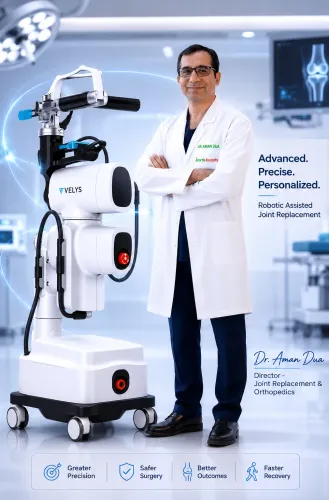
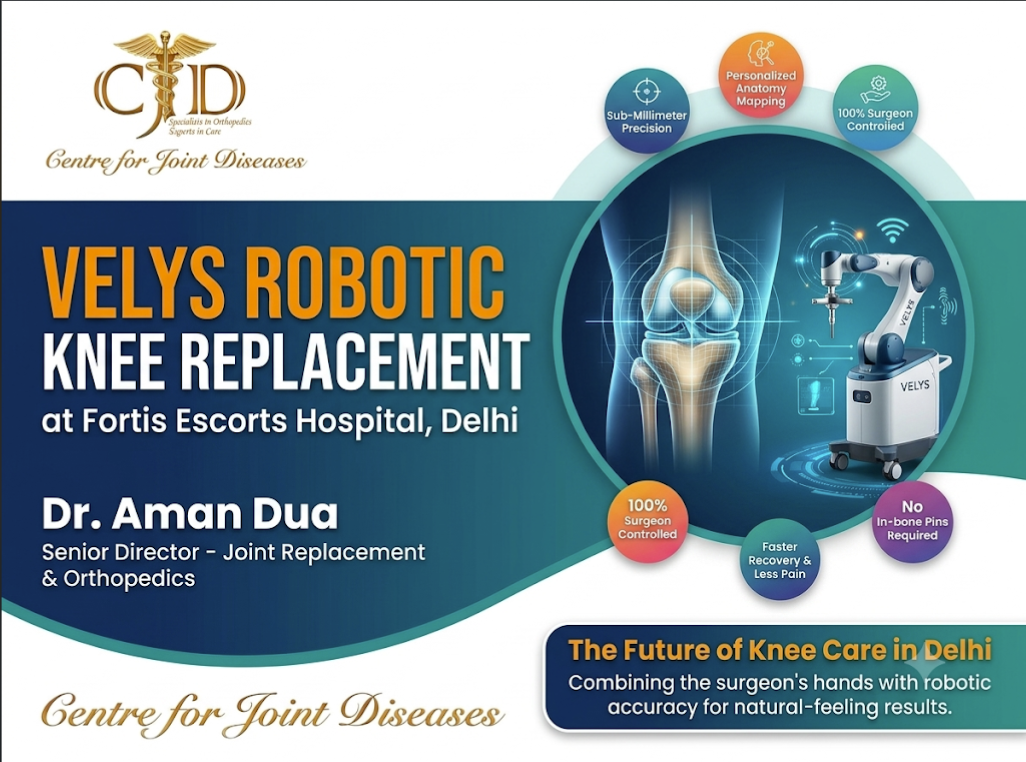
The VELYS Robotic-Assisted Solution is a computer-assisted surgical system used during knee replacement to help the surgeon plan and perform the procedure with greater precision. It does not operate independently; Dr. Aman Dua remains in control throughout the surgery, while VELYS provides real-time guidance for implant positioning, alignment, and bone preparation.
For patients researching robotic knee replacement in Delhi, the key point is simple: VELYS is a tool that supports surgical accuracy. The outcome still depends on careful diagnosis, patient selection, surgical experience, implant choice, and post-operative care.
What is the VELYS Robotic-Assisted Solution?
VELYS is a robotic-assisted platform designed for total knee replacement. It helps the surgeon assess the patient’s knee anatomy during surgery and execute a personalised surgical plan.
Unlike systems that require pre-operative CT or MRI scans, VELYS is an image-free system. It uses optical trackers and an infrared camera to collect real-time information about the knee during the operation.
The system is designed to assist the surgeon in:
- Understanding the patient’s knee anatomy.
- Planning implant position and alignment.
- Preparing bone accurately.
- Balancing the knee through its range of movement.
- Positioning the implant according to the planned alignment.
Does the VELYS robot perform the surgery?
No. The VELYS system does not perform knee replacement on its own. The orthopedic surgeon performs the operation and makes all clinical decisions.
VELYS assists by providing real-time data and helping the surgeon maintain the planned bone-cut plane during preparation. The surgeon remains in full control of incision, exposure, ligament balancing, implant selection, and final implant placement.
Think of VELYS as an advanced navigation and precision-assistance system—not an autonomous robot.
How does VELYS work during knee replacement?
The VELYS workflow generally involves the following steps:
1. Real-time knee assessment
During surgery, optical trackers are attached to the leg. An infrared camera tracks the position and movement of the knee, helping the system build a real-time understanding of the patient’s anatomy.
2. Personalised surgical planning
The surgeon uses the system’s data to evaluate alignment, joint stability, and movement through the knee’s range of motion. This helps plan the most suitable implant position for that patient’s knee.
3. Precise bone preparation
VELYS helps guide bone cuts according to the surgical plan. The system is designed to assist the surgeon in maintaining accuracy during bone preparation.
4. Implant balancing and positioning
Before the implant is finally fixed, the surgeon can reassess knee stability and movement. The goal is to achieve balanced soft-tissue tension and appropriate implant alignment through the knee’s range of motion.
Why is VELYS useful for knee replacement patients?
For suitable patients, VELYS may support:
- More personalised implant alignment.
- Real-time assessment of knee movement and stability.
- Accurate bone preparation.
- Better visualisation of alignment during surgery.
- A streamlined surgical workflow without routine pre-operative CT or MRI scanning
These advantages can be particularly relevant for patients with knee deformity, complex anatomy, or arthritis that has altered the normal alignment of the leg.
Does VELYS guarantee a painless or perfect knee?
No. VELYS can assist precision, but it cannot guarantee a painless recovery or a perfect outcome. Knee replacement still involves post-operative pain, swelling, stiffness, and rehabilitation.
Possible risks of knee replacement include infection, blood clots, stiffness, implant loosening, nerve or blood-vessel injury, and the need for revision surgery in some cases. Robotic assistance does not remove these risks.
Who may be a candidate for VELYS-assisted knee replacement?
VELYS-assisted knee replacement may be considered for patients with advanced knee arthritis who need knee replacement surgery. It may be particularly relevant when precise alignment and soft-tissue balance are important.
A consultation helps determine whether:
- Knee replacement is needed at this stage.
- Non-surgical options are still appropriate.
- Robotic assistance is suitable for the patient’s knee condition.
- The expected benefits justify the procedure.
- The patient is medically fit for surgery.
What happens after VELYS knee replacement?
After surgery, recovery focuses on pain control, swelling management, safe mobilisation, knee movement, muscle strengthening, and gradual return to daily activities.
The exact timeline varies by patient. Factors such as age, fitness, severity of arthritis before surgery, medical conditions, and adherence to follow-up care influence recovery.
Why consult Dr. Aman Dua?
Choosing robotic knee replacement is not only about choosing a machine. It is about choosing a surgeon who can assess whether surgery is needed, select the appropriate approach, use the technology appropriately, and guide recovery safely.
Dr. Aman Dua is an orthopedic and knee and hip joint replacement surgeon with M.S. Orthopedics from AIIMS, New Delhi, D.N.B. Orthopedics, and 23 years of experience. His practice, Centre For Joint Diseases, is based at Fortis Escorts Hospital, Okhla Road, Delhi.
Book a consultation at Fortis Escorts Hospital
If you have chronic knee pain and want to understand whether VELYS-assisted knee replacement is suitable for you, book a consultation with Dr. Aman Dua.
Dr. Aman Dua
Centre For Joint Diseases
Fortis Escorts Hospital, Okhla Road, Near Sukhdev Vihar Metro Station, Delhi 110025
Phone: +91 9625440750
Hospital contact: +91-8750005633
Timings: Monday–Saturday, 10:00 AM–4:00 PM
Website: https://www.fasttrackkneereplacement.com/
FAQs
Does the VELYS robot perform knee replacement by itself?
No. The surgeon performs the surgery. VELYS provides real-time guidance and assists with precision during the procedure.
Do I need a CT scan or MRI before VELYS knee replacement?
VELYS is an image-free robotic-assisted system, meaning it generally does not require pre-operative CT or MRI scans for planning. Your surgeon will decide whether any imaging is needed based on your case.
Is VELYS knee replacement painful?
The robotic system does not make surgery painless. Some post-operative pain, swelling, and stiffness are normal and are managed through a planned recovery protocol.
Is VELYS suitable for every knee replacement patient?
Not necessarily. Suitability depends on the severity and pattern of arthritis, knee deformity, bone quality, medical fitness, and the surgeon’s assessment.
How is VELYS different from conventional knee replacement?
Conventional knee replacement relies on standard instruments and the surgeon’s planning. VELYS adds real-time optical tracking and computer-assisted guidance to support implant alignment and bone preparation.
Keywords