 Sukhdev Vihar Metro, Delhi 110025
Am I Too Young or Too Old for Knee Replacement? The Real Answer — Dr. Aman Dua, Delhi
By Dr. Aman Dua | Orthopedic & Joint Replacement Surgeon | Fortis Escorts Hospital, New Delhi
Category: Patient Education | Reading Time: ~8 Minutes | Updated: October 2026
It is one of the first things patients ask when they sit down in Dr. Aman Dua's consultation room at Fortis Escorts Hospital in Delhi: 'Doctor, am I too young for this surgery?' Or, from the patient's elderly mother seated beside them: 'Doctor, she is 74 — is she too old for this?'
The truth — backed by international orthopaedic guidelines and decades of surgical evidence — is that there is no fixed minimum or maximum age for knee replacement surgery. The question that actually matters is not how old you are. It is how much your damaged knee is taking away from your life.
In this detailed guide, Dr. Aman Dua addresses every age-related concern patients across Delhi NCR — from South Delhi and Noida to Gurugram and Faridabad — bring to the clinic before deciding on surgery.
The Short Answer: There Is No Age Limit for Knee Replacement
International orthopaedic guidelines — from the American Academy of Orthopaedic Surgeons (AAOS) to the British Orthopaedic Association — have never set a minimum or maximum age for knee replacement surgery. This is not a technicality. It is a clinical fact that reflects a fundamental truth about the procedure:
The decision to recommend knee replacement is based on the severity of joint damage, the degree of pain, the impact on daily life, and the patient's overall fitness for surgery — never on age alone.
A 44-year-old with severe post-traumatic arthritis and bone-on-bone damage may need — and will benefit enormously from — knee replacement. An 80-year-old with a healthy heart and controlled blood pressure can safely undergo the same procedure and walk comfortably within days.
Why Do People Think There Is an Age Limit?
This myth has a reasonable origin. Decades ago, knee implants had a lifespan of 10 to 15 years. A patient who received surgery at 45 would almost certainly need a revision (second) surgery by their mid-50s — which is more complex and carries greater risk. So surgeons conservatively advised patients to wait until they were older.
That advice is now outdated. Modern implant technology — including the advanced systems Dr. Aman Dua uses at Fortis Escorts Hospital — has extended implant lifespans to 20–25 years or more. A patient who undergoes surgery at 48 today may never need a revision at all. The entire calculation has changed.
Knee Replacement at Different Ages: What You Need to Know
Knee Replacement in Your 40s — 'Am I Too Young?'
Patients in their 40s with severe knee damage — often due to post-traumatic arthritis following an old injury, rheumatoid arthritis, or avascular necrosis — are increasingly choosing surgery rather than losing years of productive, active life to pain.
Key considerations for patients in their 40s:
• Modern high-flex implants last 20–25+ years — long enough to outlast the need for revision in many patients
• Younger patients are generally fitter, heal faster, and achieve better range of motion post-surgery
• The risk of waiting — muscle wasting, weight gain, depression, and additional joint damage — often outweighs the risk of early surgery
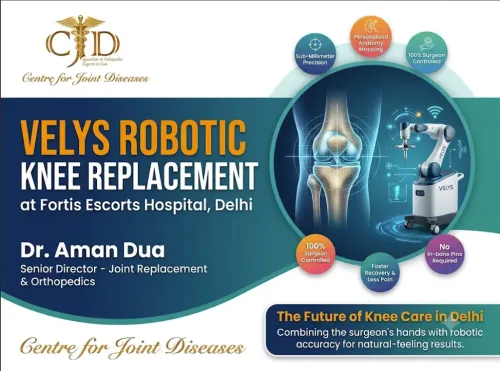
• Robotic-assisted surgery, available at Fortis Escorts Hospital with Dr. Aman Dua, ensures sub-millimetre implant accuracy that maximises longevity
'A 48-year-old who cannot play with their children, exercise, or travel comfortably is not well served by advice to wait another 15 years.' — Dr. Aman Dua
Knee Replacement in Your 50s and Early 60s — The 'Sweet Spot'
Patients in their 50s and early 60s represent the fastest-growing group seeking knee replacement in Delhi NCR. This is the age at which osteoarthritis typically reaches its most disabling stage, yet patients are still active enough to benefit fully from surgery.
• Most patients in this age group achieve excellent functional outcomes — walking, climbing stairs, and resuming normal activities within 6–8 weeks
• Implants placed at this age are statistically very likely to last for the rest of the patient's lifetime
• Recovery is faster and more complete than for older patients due to greater muscle strength and cardiovascular fitness
• For working professionals in Gurugram and Noida, this is the age at which pain is most likely to interfere with career and family life — making timely surgery especially important
Knee Replacement in Your 60s and 70s — The Most Common Age Group
This remains the most common age range for knee replacement globally and in Delhi NCR. Patients in their 60s and 70s consistently report the highest satisfaction rates — often describing surgery as a transformation they wish they had undergone sooner.
• Biological fitness — not chronological age — determines surgical safety
• Pre-operative assessment including cardiac evaluation, blood tests, and anaesthesia review is performed for all patients
• Pain relief is dramatic and typically immediate following surgery
• Most patients in this group are walking within 24 hours and discharged within 3–5 days under Dr. Aman Dua's Fast Track Recovery protocol
Knee Replacement at 75, 80, and Beyond — 'Am I Too Old?'
There is no official maximum age for knee replacement surgery. Patients in their late 70s and 80s regularly undergo successful surgery at Fortis Escorts Hospital. The key assessment is biological age — the condition of the heart, lungs, kidneys, and overall physical reserves — not the number on a birth certificate.
• An 80-year-old with a healthy heart, well-controlled blood pressure, and no severe comorbidities is a safe surgical candidate
• Modern anaesthesia — including spinal blocks — reduces systemic risk significantly compared to general anaesthesia
• For elderly patients, the risk of not having surgery — continued immobility, falls, depression, and dependence — often exceeds the surgical risk
• An implant placed in an 80-year-old is statistically extremely unlikely to wear out within the patient's remaining years — the revision concern does not apply
Dr. Aman Dua has successfully performed knee replacement on patients well into their 80s at Fortis Escorts Hospital. Age, by itself, has never been a reason to deny a patient the possibility of a pain-free life.
What Actually Determines Whether You Need Knee Replacement
Rather than asking 'Am I the right age?', the more useful questions are:

Common Myths About Age and Knee Replacement — Answered by Dr. Aman Dua
Myth: 'I Should Wait Until I Am Older'
Fact: Waiting beyond the point of clear surgical indication causes progressive muscle wasting, additional joint damage, weight gain due to inactivity, and increased cardiac and metabolic risk. Early surgery in appropriate candidates leads to better outcomes, not worse.
Myth: 'Elderly Patients Cannot Handle the Anaesthesia'
Fact: The overwhelming majority of knee replacements are now performed under spinal anaesthesia — which is far safer than general anaesthesia for elderly patients. Dr. Aman Dua's anaesthetic team at Fortis Escorts Hospital performs a thorough pre-operative evaluation to ensure every patient is appropriately optimised before surgery.
Myth: 'Young Patients Will Definitely Need a Second Surgery'
Fact: With modern high-flex implants lasting 20–25 years or more, a patient operated at 45 has a reasonable chance of never needing revision. And even if revision becomes necessary in the future, it is a manageable procedure — far less debilitating than 15 more years of severe arthritis.
Myth: 'Diabetes and High Blood Pressure Mean I Cannot Have Surgery'
Fact: Well-controlled diabetes and hypertension are not contraindications to knee replacement. Dr. Aman Dua's team ensures thorough pre-operative medical optimisation. Patients with controlled comorbidities undergo surgery safely at Fortis Escorts Hospital every day.
Frequently Asked Questions — Age and Knee Replacement
Q1: What is the youngest age at which Dr. Aman Dua has performed knee replacement?
Dr. Aman Dua has performed knee replacement on patients in their early 40s — typically those with severe post-traumatic arthritis or rheumatoid arthritis causing Grade 4 joint damage. The decision is always based on clinical assessment, not age alone.
Q2: Is recovery harder for older patients?
Recovery does take somewhat longer for older patients — primarily because of slower healing and lower baseline fitness. However, with Fast Track Recovery protocols, supervised physiotherapy, and appropriate pain management, elderly patients consistently achieve excellent functional outcomes at Fortis Escorts Hospital. The harder factor is delay — the longer surgery is postponed, the weaker the muscles become, making recovery progressively harder.
Q3: My doctor told me I am 'too young at 52' for knee replacement. Is this correct?
This reflects an outdated understanding of implant longevity. Modern implants last 20–25 years or more. A 52-year-old with severe, bone-on-bone arthritis who has exhausted non-surgical options is a medically appropriate candidate for surgery. We recommend seeking a second opinion from a specialist with experience in contemporary implant technology.
Q4: Can knee replacement be performed if I have a heart condition?
Many patients with well-managed cardiac conditions safely undergo knee replacement. A pre-operative cardiology clearance is mandatory, and spinal anaesthesia is typically preferred. Dr. Aman Dua coordinates closely with cardiologists at Fortis Escorts Hospital to ensure cardiac patients are fully optimised before surgery.
Q5: Is there a weight limit for knee replacement surgery?
Obesity is not an absolute contraindication, but it does increase surgical risk and may affect outcomes. For significantly obese patients, Dr. Aman Dua typically recommends a structured weight management programme before surgery to improve results and reduce complications.
When Is the Right Time for You? Let Dr. Aman Dua Decide — Not Your Age
The most important step you can take today is not to decide whether you are too young or too old — it is to have a proper clinical assessment. A 30-minute consultation with Dr. Aman Dua at Fortis Escorts Hospital will tell you more about your knee's condition, your surgical readiness, and your expected outcomes than any age calculation ever could.
Patients from South Delhi, Okhla, Noida, Greater Noida, Gurugram, Faridabad, and across the NCR region visit Dr. Aman Dua's clinic regularly. Whatever your age, whatever your concerns — you deserve a clear, honest answer about what surgery can do for you.

Related Reading:
• Robotic-Assisted Joint Replacement Delhi | • Hip Replacement Surgery Delhi | • Revision Knee Replacement Delhi | • Knee Arthritis Treatment Delhi NCR
© 2026 Dr. Aman Dua | Fortis Escorts Hospital, Delhi | fasttrackkneereplacement.com
Keywords