Hip Resurfacing vs Total Hip Replacement — A Guide for Active Indians
Hip resurfacing and total hip replacement are both surgical treatments for hip arthritis, but they are not interchangeable. Hip resurfacing preserves more of the thigh bone and may suit selected younger, active patients, while total hip replacement is a more widely suitable option across different ages, bone quality, and arthritis patterns.
For active Indians who want to return to walking, cycling, swimming, gym training, or work without hip pain, the right choice depends on age, bone strength, anatomy, activity goals, and medical fitness—not simply on the desire for a “bone-preserving” procedure.
What is hip resurfacing?
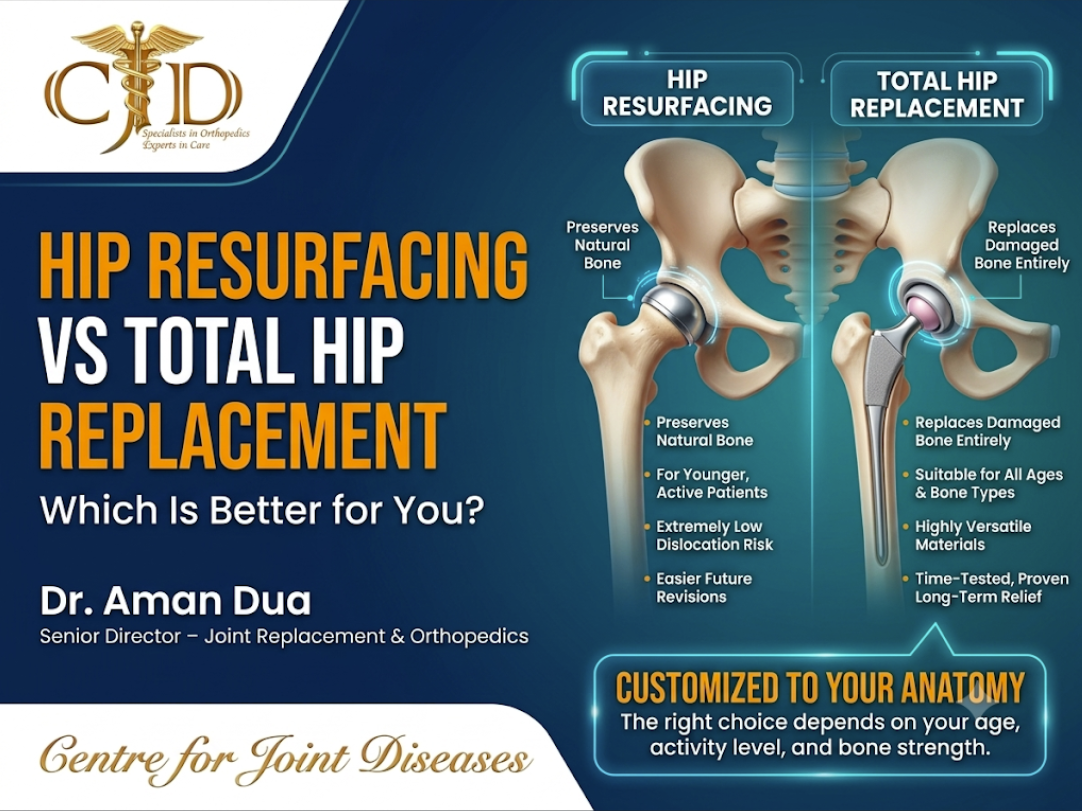
In hip resurfacing, the damaged surface of the femoral head—the ball of the hip joint—is trimmed and covered with a smooth metal cap. The femoral head is not removed. The hip socket is also resurfaced with an implant.
Because more of the natural thigh bone is preserved, hip resurfacing is often discussed for younger, active patients with good bone quality.
What is total hip replacement?
In total hip replacement, the damaged femoral head is removed and replaced with a prosthetic ball attached to a stem placed inside the thigh bone. The hip socket is also replaced with an artificial cup and liner.
Total hip replacement is one of the most established treatments for advanced hip arthritis and can be suitable for a broader range of patients, including older adults and those with weaker bone or complex hip anatomy.
Hip resurfacing vs total hip replacement: key differences

Who may be suitable for hip resurfacing?
Hip resurfacing may be considered for carefully selected patients who are:
- Generally younger, often under 60, though age alone is not the only factor.
- Physically active and motivated to maintain a higher activity level.
- Have good bone quality and appropriate femoral head size.
- Have hip arthritis or certain hip conditions suitable for resurfacing.
- Do not have significant bone loss, deformity, osteoporosis, or other factors that make resurfacing unsuitable.
Hip resurfacing is not appropriate for everyone. Patients with poor bone quality, large cysts, severe deformity, infection risk, kidney disease, or certain metal-sensitivity concerns may be better served by total hip replacement.
Who may need total hip replacement?
Total hip replacement may be more appropriate when:
- Arthritis is advanced and affects the whole hip joint.
- Bone quality is poor or osteoporosis is present.
- There is significant deformity or bone loss.
- The femoral head is too small or unsuitable for resurfacing.
- The patient is older or has medical conditions that make resurfacing unsuitable.
- Previous hip surgery or trauma has altered the anatomy.
- The patient needs a more broadly established solution for long-term function.
Which option allows a more active lifestyle?
Both procedures aim to reduce pain and improve mobility. Hip resurfacing may appeal to selected active patients who wish to preserve bone and pursue higher-demand activities, but it requires careful patient selection.
Total hip replacement also allows many patients to return to walking, cycling, swimming, gym training, and daily activities. High-impact or contact sports may need individualised discussion with the surgeon, regardless of the procedure.
The most active outcome usually comes from choosing the right procedure for the patient’s hip, followed by structured rehabilitation and realistic activity progression.
What are the risks of hip resurfacing?
Hip resurfacing carries risks similar to other hip surgeries, including:
- Infection.
- Blood clots.
- Dislocation.
- Nerve injury.
- Fracture around the implant.
- Stiffness or extra bone formation.
- Implant wear or loosening.
- Metal-related concerns in certain implant designs.
Because many resurfacing implants are metal-on-metal, metal ion levels and metal reaction risks need careful consideration.
What are the risks of total hip replacement?
Total hip replacement also carries surgical risks, including:
- Infection.
- Blood clots.
- Dislocation.
- Leg-length difference.
- Nerve or blood-vessel injury.
- Implant loosening or wear over time.
- Periprosthetic fracture.
- Need for revision surgery in some cases.
Modern surgical planning, implant selection, and rehabilitation help manage these risks, but no surgery is risk-free.
Which recovery is faster?
Recovery depends more on the individual patient than on the name of the procedure. Both surgeries involve early mobilisation, pain control, swelling management, and progressive strengthening.
Patients who are younger, fitter, and well-supported at home may recover more quickly after either procedure. Those with muscle weakness, obesity, anaemia, diabetes, or other medical conditions may need a more gradual recovery plan.
How does a surgeon decide?
A hip specialist evaluates:
- Location and severity of hip pain.
- Walking pattern, stiffness, and range of motion.
- X-rays and, when required, advanced imaging.
- Bone quality and femoral head anatomy.
- Age, weight, and activity goals.
- Medical history and medication use.
- Previous hip surgery or trauma.
- Patient expectations regarding sport, work, and lifestyle.
Hip resurfacing should not be chosen only because it preserves bone. It should be chosen when the patient’s anatomy and goals genuinely make it a safe and appropriate option.
Why consult Dr. Aman Dua?
Hip pain can arise from arthritis, avascular necrosis, hip impingement, labral tears, trauma, or other conditions. Correct diagnosis is essential before deciding between resurfacing and replacement.
Dr. Aman Dua is an orthopedic and knee and hip joint replacement surgeon with M.S. Orthopedics from AIIMS, New Delhi, D.N.B. Orthopedics, and 23 years of experience. His practice, Centre For Joint Diseases, focuses on hip arthritis, joint replacement, and related orthopedic care in Delhi.
Book a hip consultation in Delhi
If hip pain is limiting your walking, sleep, work, or active lifestyle, a specialist assessment can help you understand whether hip resurfacing, total hip replacement, or another treatment is suitable.
Dr. Aman Dua
Centre For Joint Diseases
Fortis Escorts Hospital, Okhla Road, Near Sukhdev Vihar Metro Station, Delhi 110025
Phone: +91 9625440750
Hospital contact: +91-8750005633
Timings: Monday–Saturday, 10:00 AM–4:00 PM
Website: https://www.fasttrackkneereplacement.com/
FAQs
Is hip resurfacing better than total hip replacement?
Neither is better for everyone. Hip resurfacing may suit selected younger, active patients with good bone quality, while total hip replacement is suitable for a broader range of patients and arthritis patterns.
Can I run after hip resurfacing?
Some selected patients may return to higher-impact activities, but this should be discussed individually with the surgeon. Activity recommendations depend on bone quality, implant type, and surgical outcome.
Is hip resurfacing only for young patients?
It is more commonly considered in younger, active patients, but age alone does not decide suitability. Bone quality, anatomy, activity goals, and medical fitness matter more.
Is total hip replacement safe for active people?
Yes, many active patients undergo total hip replacement and return to walking, cycling, swimming, and gym-based exercise. High-impact activities require individualised advice.
Which surgery has a longer lifespan?
Implant longevity depends on patient selection, bone quality, activity level, weight, surgical technique, and implant type. Both procedures can last many years in appropriately selected patients.
Keywords